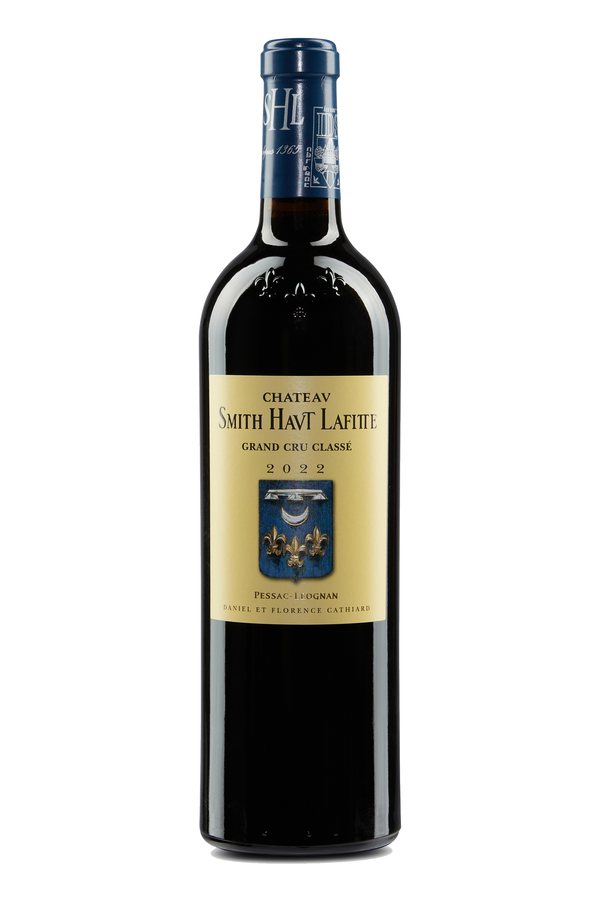
Chateau Smith Haut Lafitte
100pointsJeb Dunnuck · 2022 vintage- Region
- France, Bordeaux
- Appellation
- Pessac-Léognan Grand Cru Classé
- Grapes
- 64% Cabernet Sauvignon, 32% Merlot, 3% Cabernet Franc, 1% Petit Verdot (2022)
- Color
- Red
- Vintages
- 2022, 2019, 2014, 2009
- Mevushal
- No
- Supervision
- OU; Rabbi Its’hak Katz Kehal Yereim Paris Chareidi
Scores by vintage
56 scores of 90 points and above across 4 vintages.
One of the greatest wines from the estate.
- 100Decanter2022
- 98James Suckling2022
- 98Jane Anson2022
- 98Jeff Leve2022
- 97Falstaff2022
- 97+Vinous2022
- 97Wine Enthusiast2022
- 96+Wine Advocate2022
8 more scores for 2022
- 100Vert de Vin2022
- 98Terre de Vins2022
- 98Vinum2022
- 97Jean-Marc Quarin2022
- 96Le Figaro Vin2022
- 95+Vinous · A. Galloni2022
- 95Wine Spectator2022
- 95–97The Wine Independent2022Barrel
This shows finesse with structure.
- 99Jane Anson2019
- 98Jeb Dunnuck2019
- 97Decanter2019
- 97The Wine Independent2019
- 97Falstaff2019Barrel
- 96Vinous · A. Galloni2019
- 96Wine Advocate2019
- 96–98Wine Enthusiast2019Barrel
7 more scores for 2019
- 98Alexandre Ma2019
- 98Le Figaro Vin2019
- 98Vert de Vin2019
- 97Bettane & Desseauve2019
- 96Jean-Marc Quarin2019
- 95Wine Spectator2019
- 17.5/20Jancis Robinson2019
A big black-cherry and bitter-chocolate nose.
- 94Decanter2014
- 94Vinous2014
- 94Wine Spectator2014
- 93Jeb Dunnuck2014
- 93Vinous · A. Galloni2014
- 93Wine Advocate2014
- 17.5/20Jancis Robinson2014
1 more score for 2014
- 18/20René Gabriel2014
The finest wine ever made by proprietors Daniel and Florence Cathiard.
- 100Jeb Dunnuck2009
- 98Decanter2009
- 98Jeff Leve2009
- 96James Suckling2009
- 96Jane Anson2009
- 96Wine Spectator2009
- 94Wine Enthusiast2009
- 17/20Jancis Robinson2009
5 more scores for 2009
- 97La RVF2009
- 96Jean-Marc Quarin2009
- 96Vert de Vin2009
- 95Andreas Larsson2009
- 19/20René Gabriel2009
Scores are for the vintages we carry. Ranges are barrel-sample scores given before bottling.
Expert Notes
“A big black-cherry and bitter-chocolate nose leads into a rich, concentrated palate, where the fruit easily holds sway over the powerful, dry tannins. It’s these that drive everything along right through to the assertive, slightly earthy finish; impressive long-term stuff!” - James Suckling
Tasting Notes
Dark purple with cassis and black fruit on the nose. Full bodied, deeply extracted with classic velvety texture only Smit Haut wines can resemble.
Food Pairing
Ideal with classic meat dishes, veal, beef, lamb, duck, game, roast chicken, roasted, braised and grilled dishes.
Serve at 17 to 18°C (63 to 65°F). Decant young vintages for an hour.
The Region
Pessac-Léognan is a prestigious appellation for red wine in the Bordeaux region of south-western France. It was carved out of the Graves sub-region in 1987 as recognition for its high quality red and white wines. Many of the estates in what is now Pessac-Léognan were the best performers in the Graves Classification of 1959. The regions wines tend to be based on the Cabernet Sauvignon and Cabernet Franc grape varieties. They best suit the terroir of Pessac-Léognan. The dominant soil type is the same gravel (and sand) which gave Graves its name. The red grape varieties of the appellation covers approximately 1491 hectares (3684 acres).
The Grape
Cabernet Sauvignon – Merlot wines are made from two of the world's most famous and most widely grown wine grapes. The pair form the foundation of many of the great wines of Bordeaux, where this classic blend (often dubbed "Bordeaux Blend") is thought to have originated. For centuries, Cabernet Sauvignon and Merlot have been the quintessential Bordeaux wine grapes, but their fame and popularity have now taken them far beyond the banks of the Garonne, Dordogne and Gironde, to the furthest reaches of the wine world. In California the blend is often labeled as Meritage – providing the producer meets the requirements of the Meritage Alliance. The Australian regions of Coonawarra, Margaret River and Yarra Valley are highly regarded for their unique expressions of the blend. South Africa's Stellenbosch region also produces some earthy and savory examples that defy many of the commonly held perceptions about New World wine. In other New World countries the blend is often abbreviated to Cabernet Merlot, although this mix could include Cabernet Franc as well.